
Cancer Screening Camps at Pennalam Hospital: What to Expect
Walking into a hospital when you feel completely fine can seem counterintuitive. Most of us visit a doctor only when something hurts, when a persistent fever refuses to subside, or when a chronic symptom disrupts our daily routine. Because of this habit, the idea of attending a cancer screening camp often brings hesitation, awkward questions, or quiet anxiety.
Many people wonder: Why should I go if I have no symptoms? Will the tests be painful or embarrassing? What happens if they actually find something abnormal?
Cancer screening camps exist to address these exact concerns. They are designed for healthy people who have no symptoms, offering a safe, affordable, and comfortable space to verify their health status.
At Penn Nalam Hospital in Chennai, community cancer screening camps have been a core mission for years. Established under the Sri Gopala Sundaram Medical Trust, Penn Nalam focuses on women’s wellness, breast health, and cervical cancer prevention, ensuring that high-quality preventive healthcare is accessible to women across Chennai and surrounding districts.
If you have never attended a community medical camp or feel nervous about booking your slot, this guide walks you through every single step, explaining what happens from the moment you register to the day you receive your results.
Why Cancer Screening Matters for Everyone
To understand the purpose of a screening camp, it helps to understand how cancer develops.
Most major cancers, particularly breast, cervical, and oral cancers, do not appear overnight. They develop gradually over years, often starting as tiny, harmless-looking microscopic changes or benign cellular growths. During these early phases, a person feels completely energetic, healthy, and pain-free.
By the time a noticeable lump, unexplained bleeding, or stubborn non-healing ulcer shows up, the condition has often reached an advanced stage, requiring intensive, costly, and lengthy medical treatments.
Screening turns the odds in your favor:
- Early Detection Saves Lives: Breast cancer caught at Stage 1 has a survival rate exceeding 90%. Cervical cancer caught at the precancerous stage can be completely cured with a simple minor procedure.
- Simpler Treatments: Early discovery means simpler surgeries, lower doses of medication, and a faster return to everyday life.
- Affordability: Advanced cancer care places a severe financial burden on families. Routine screening prevents that distress by catching problems before they demand complex medical interventions.
- Peace of Mind: For the vast majority of attendees, screening tests come back completely clear, offering deep relief for both the individual and their family.
The Core Philosophy Behind Penn Nalam Hospital Camps
Penn Nalam Hospital was founded with a clear objective: to make preventive oncology approachable, dignified, and affordable for every woman, regardless of her financial background.
Many women across Chennai put off preventive health visits due to three common obstacles:
- High Costs: Private corporate diagnostic centers often charge hefty fees for specialized scans like digital mammograms and Pap tests.
- Fear and Stigma: Many women feel shy or uncomfortable discussing breast changes, menstrual irregularities, or reproductive health with male doctors or in crowded general outpatient wards.
- Lack of Time: Between household duties and professional work, setting aside half a day to navigate large hospital corridors feels impossible.
Penn Nalam tackles these hurdles head-on. Their screening camps are organized specifically to provide compassionate, female-led clinical examinations, high-precision mobile diagnostic tools, and deeply subsidized or free packages. Whether conducted on-site at their facilities in Mogappair and Nerkundram or through mobile medical units touring corporate offices, residential welfare communities, and rural belts around Chennai, these camps prioritize comfort, patient privacy, and clinical accuracy.
What Types of Screenings Are Conducted at the Camps?
While camps can be customized depending on the community or corporate partner, Penn Nalam camps primarily focus on the most prevalent cancers affecting women.
Breast Cancer Screening
Breast cancer is the most common cancer among Indian women today. At a Penn Nalam camp, breast evaluation is carried out in progressive steps:
- Clinical Breast Examination (CBE): An experienced female doctor or trained oncology nurse performs a gentle physical exam to check for lumps, skin thickening, nipple changes, or swollen lymph nodes around the armpits and collarbones.
- Breast Self-Exam (BSE) Training: The clinical team demonstrates how to perform a monthly breast self-exam at home. Learning what your breast tissue normally feels like makes spotting unusual changes straightforward.
- Digital Mammography or Sonomammography: For women aged 40 and above, or younger women presenting with dense breast tissue or palpable lumps, digital mammograms or specialized breast ultrasounds are conducted. Mobile screening units bring these high-resolution imaging machines directly to community sites, eliminating the need to travel to a tertiary hospital.
Cervical Cancer Screening
Cervical cancer is almost 100% preventable if precancerous cellular changes are identified and addressed early.
- Pap Smear Test: A quick, painless swab collected from the cervix to detect abnormal or inflamed cells under a microscope.
- Visual Inspection under Acetic Acid (VIA): A simple, immediate visual test using dilute acetic acid to identify precancerous lesions on the cervix, widely used in outreach camps.
- HPV Screening Guidance: Education on Human Papillomavirus infections and advice on cervical cancer vaccination for young girls and adult women.
Oral Cancer Screening
Oral cancer rates remain high across South India due to the use of chewing tobacco, gutka, paan, and betel quid.
During an oral screening check:
- A doctor carefully inspects the mouth, lips, gums, tongue, inner cheeks, and roof of the mouth using bright lighting.
- The physician checks for red or white patches (erythroplakia or leukoplakia) and non-healing sores.
- The neck is examined for swollen lymph nodes.
General Health and Metabolic Vitals
Because overall wellness supports cellular defense, most camps include basic health assessments:
- Blood pressure check
- Random blood sugar (glucose) test
- Body Mass Index (BMI) and weight evaluation
Step-by-Step: What to Expect on Camp Day
If you have booked a slot or plan to walk into a screening camp at Penn Nalam Hospital, here is a detailed look at how your day unfolds.
Step 1: Warm Welcome and Registration
When you arrive at the camp venue, you will be greeted by reception staff and medical coordinators.
You will fill out a basic intake form (with assistance available in Tamil and English). The form asks for:
- Basic personal details (name, age, contact number)
- Brief medical history (known conditions like diabetes, hypertension, thyroid disorders)
- Reproductive history (age of first period, number of pregnancies, breastfeeding history, menopause status)
- Family medical tree (whether any close relative, such as a mother, sister, or aunt, has had breast, ovarian, or colon cancer)
Keep your identity proof and any previous medical files or mammogram reports handy.
Step 2: Basic Health Vitals
Before seeing the doctor, a nurse checks your baseline vitals:
- Measuring your blood pressure using a digital or manual cuff.
- Checking your height and weight to assess your BMI.
- A quick finger-prick test to check random blood glucose levels.
These numbers give the consulting physician a quick snapshot of your general metabolic health.
Step 3: Private Consultation with a Doctor
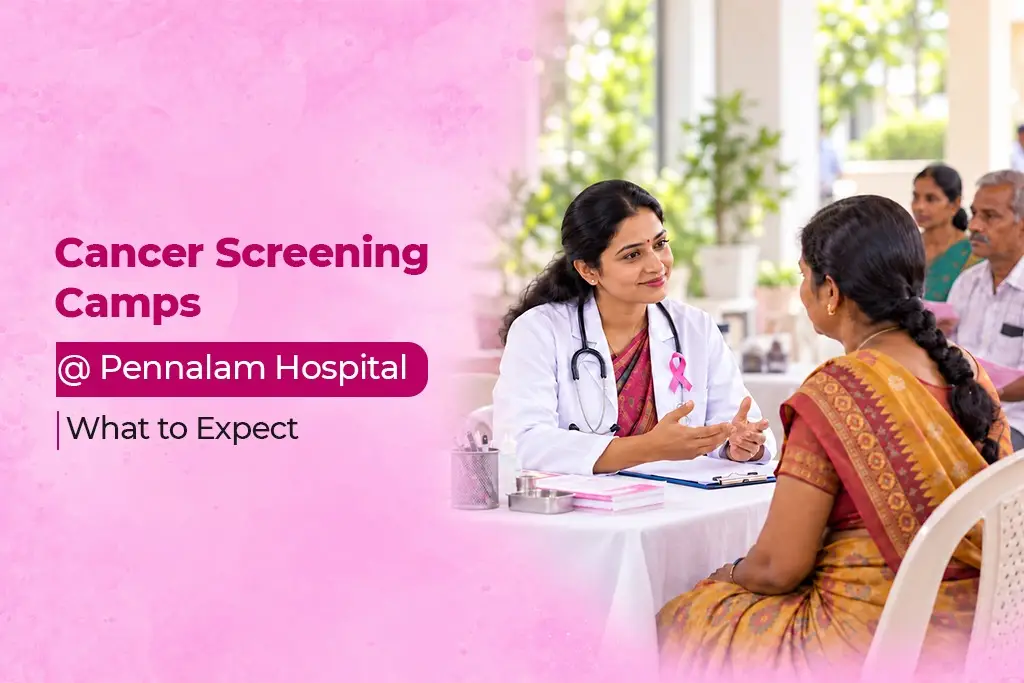
Next, you will be called into a private consultation room to speak with a physician.
This discussion is completely confidential:
- The doctor reviews your intake form and family history.
- You can discuss any symptoms you may have noticed, such as changes in your menstrual flow, unusual vaginal discharge, pelvic discomfort, or breast soreness.
- The doctor answers your questions without rushing you, clearing up any doubts or fears you might hold.
Step 4: Clinical Physical Examination
Following your consultation, the physician conducts the physical examination in a private, curtained room.
- For Breast Examination: You will be asked to undress from the waist up. A clean gown or sheet is provided to keep you comfortable. The doctor inspects the breasts while you are seated and lying down, methodically feeling the tissue for any lumps or knots.
- For Cervical Check (Pap Smear): You will lie on an examination table with your knees bent. The doctor gently inserts a sterile, lubricated instrument called a speculum into the vagina to visualize the cervix. A small, soft brush or spatula is used to collect a gentle swipe of cells. The process takes less than 60 seconds and feels like a mild pinch or dull menstrual cramp.
Strict hygiene protocols are maintained, using disposable sheets, single-use sterile instruments, and clean gloves for every individual.
Step 5: Advanced Diagnostic Scans (If Advised)
If you are 40 or older, or if the clinical examination reveals dense tissue or an unusual area, you will be guided to the imaging section.
- Mammogram: You will stand in front of a digital mammography machine. A female technician positions your breast on a smooth plastic platform. An upper plate lowers for a few seconds to compress the tissue while an X-ray image is captured from two angles. The pressure feels tight, but it lasts only a few moments.
- Ultrasound Scan: If a scan is needed to distinguish between a harmless fluid cyst and a solid tissue nodule, a warm gel is applied to the breast, and a handheld probe is guided gently over the skin.
Step 6: Counseling, Guidance, and Refreshments
After completing your checks, you will spend a few minutes with a health counselor:
- You will learn how to inspect your breasts at home each month.
- You will receive clear guidance on diet, physical exercise, and cancer prevention.
- You are given a tracking slip explaining when and how your formal laboratory reports will be shared.
Most screening camps provide clean drinking water, light snacks, or herbal tea to ensure you leave refreshed and energized.
Overcoming Common Worries: What Attendees Often Fear
It is entirely natural to feel nervous before your first screening visit. Knowing what is normal helps quiet that internal worry.
Common Concern | What Actually Happens |
“Will a mammogram be extremely painful?” | The compression feels firm for about 5 to 10 seconds per view, but it should not cause severe pain. Relaxing your shoulders and timing your scan after your periods minimizes discomfort. |
“I feel shy having private parts examined.” | The clinical staff at Penn Nalam consists of trained female doctors and nurses who handle every exam with professional respect and absolute privacy. |
“What if the test detects cancer?” | The vast majority of screening findings turn out to be completely benign, like simple hormonal cysts or minor infections. If an issue is spotted early, treatment is far simpler and highly successful. |
“Will it take up my whole day?” | A standard screening visit usually takes between 45 to 90 minutes from registration to counseling. |
What Happens After the Camp: Understanding Your Results
A screening camp is not just a one-off event; it is the starting point of your ongoing healthcare relationship.
Clear Reports
If your Pap smear, clinical exam, and mammogram show no signs of abnormalities, you will receive a clean bill of health. The medical team will provide a written report and let you know when you should schedule your next routine test (usually every 1 to 2 years for mammograms, and every 3 to 5 years for cervical screenings).
Inconclusive or Benign Findings
It is very common for tests to uncover minor, non-cancerous conditions. These might include:
- Harmless fluid-filled breast cysts
- Benign fibroadenomas
- Common cervical inflammation or mild bacterial infections
In these situations, the doctor may prescribe a short course of medication or suggest a follow-up ultrasound in six months to monitor the area.
Suspicious Findings
If a scan reveals an abnormal tissue pattern, microcalcification cluster, or irregular cervical lesion, there is no need to panic. The Penn Nalam medical team guides you through the next diagnostic steps:
- Recommending a focused biopsy or fine-needle aspiration (FNAC) to examine tissue cells under a microscope.
- Scheduling a detailed consultation with a surgical oncologist at their main hospital facility.
- Helping you access financial support, government health schemes, or subsidized treatment programs if medical intervention is needed.
The team stays by your side, ensuring you never have to navigate unexpected news alone.
How to Prepare for Your Screening Camp Visit
Taking a few simple preparation steps before you arrive helps ensure your visit is smooth, comfortable, and accurate:
- Wear Practical Two-Piece Outfits: Wear a comfortable skirt and blouse, salwar kameez, or trousers with a top. Avoid one-piece dresses so you only need to undress from the waist up for breast exams or the waist down for pelvic checks.
- Avoid Powders and Deodorants: On the day of your mammogram, do not use talcum powders, roll-on deodorants, antiperspirants, perfumes, or moisturizing creams around your chest, breasts, or armpits. These personal care products contain tiny mineral particles that can mimic calcium specks on an X-ray.
- Time Your Visit Mindfully: If you have regular periods, try to schedule your screening appointment for the week right after your menstrual flow stops. During this window, breast tissue is least tender, and Pap smear samples are clearest.
- Gather Previous Health Records: If you have had previous mammograms, breast sonograms, pelvic ultrasounds, or biopsy reports, bring them along. Comparing historical scans with new images allows radiologists to spot subtle changes with far greater precision.
- Bring a List of Questions: Write down any doubts regarding family cancer history, irregular cycles, or unusual bodily changes so you can discuss them easily with the consulting doctor.
Community and Corporate Outreach in Chennai
Beyond hosting camps at their main hospital branches in Chennai, Penn Nalam actively partners with outside groups to take early detection directly to the people:
- Corporate Wellness Drives: Partnering with IT parks in OMR, commercial hubs in Guindy, and corporate offices across Chennai to run customized women’s health checks for female employees during work hours.
- Residential Welfare Associations (RWAs): Setting up weekend screening camps in community halls across residential neighborhoods like Anna Nagar, Mogappair, Kilpauk, Ambattur, and Porur.
- Non-Profit and Rural Missions: Deploying fully equipped mobile screening vans to semi-urban towns, industrial belts, and rural villages across Tamil Nadu, offering free cancer screenings to women who lack access to specialized healthcare.
If your residential community, workplace, or non-profit trust wishes to host a screening drive, you can coordinate directly with Penn Nalam Hospital to arrange a mobile screening van and medical team.
Taking the First Step Toward Lifelong Wellness
Putting your personal health first is not selfish; it is the most caring choice you can make for your loved ones. Women hold families and workplaces together, yet they are often the last to seek medical attention.
A cancer screening camp removes the complexity, high costs, and awkwardness from preventive care. It offers a warm, private, and professional space where you can get your vitals checked, consult with dedicated female specialists, and receive high-precision scans in a single morning.
Do not wait for a warning sign to prioritize your health. Reach out to Penn Nalam Hospital in Chennai today, find out when their next screening camp is taking place, or book a preventive health package for yourself, your mother, or your sister. A simple, one-hour visit today protects years of vibrant, healthy tomorrows.