

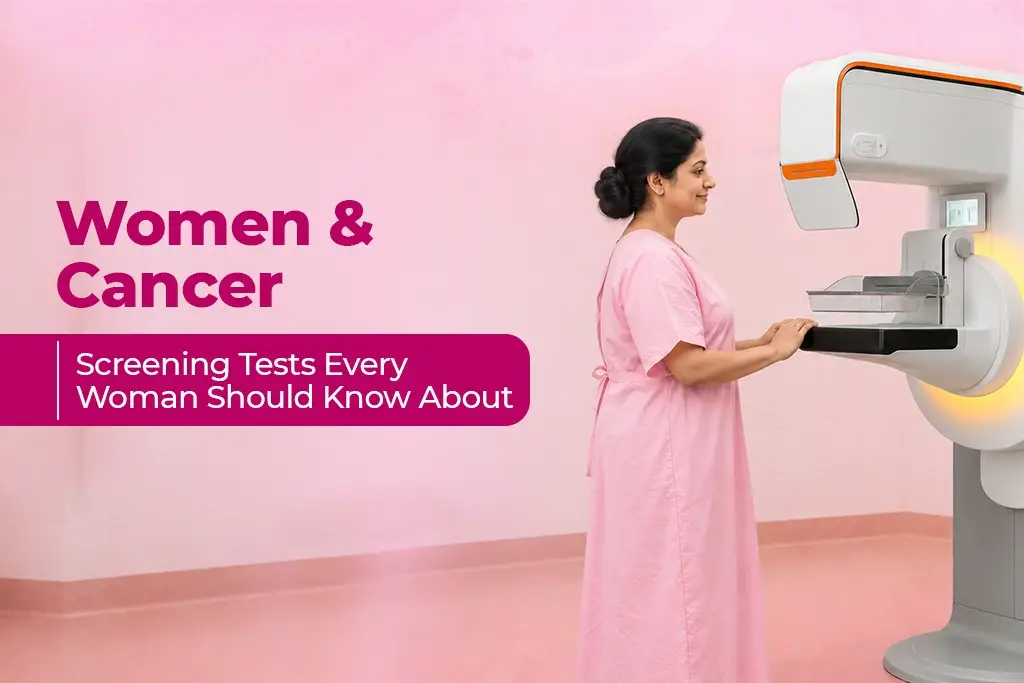
Women & Cancer: Screening Tests Every Woman Should Know About
When was the last time you took a morning off work or paused your family responsibilities just to get a routine health check?
For most women, the honest answer is usually “not recently.” In Indian households, women take on the role of default caretakers. From managing busy careers and home routines to looking after elderly parents and raising children, personal health quietly drops to the bottom of the to-do list. Medical visits happen only when pain becomes intolerable or an undeniable symptom interferes with everyday life.
Cancer rarely begins with loud warning bells. In its earliest phases, abnormal cells divide quietly without causing pain, fever, or noticeable illness. By the time a visible lump, unexplained bleeding, or stubborn fatigue forces a visit to the clinic, the condition may have already advanced.
Screening tests change that reality. Cancer screening is designed specifically for people who feel completely healthy and have no symptoms. These simple tests catch cellular abnormalities and microscopic changes long before they turn into invasive disease.
Whether you live in Anna Nagar, Kilpauk, Nerkundram, Velachery, or anywhere across Chennai, understanding your screening options gives you the upper hand over cancer. Here is everything you need to know about essential cancer screenings, when to start them, and how they protect your future.
The Difference Between Screening and Diagnosis
Many women hesitate to schedule screening tests because of a simple misunderstanding. They assume that getting tested means the doctor already suspects they have cancer.
That is not how screening works:
- Screening tests are performed on people with zero symptoms. The goal is to detect precancerous changes or early-stage cancer so treatment is minor, simple, and highly effective.
- Diagnostic tests happen when a woman already noticed a warning sign, such as a breast lump, abnormal vaginal bleeding, or chronic pelvic pain. The doctor runs focused scans and biopsies to pinpoint the exact cause of that specific symptom.
Going for a screening test does not mean you are sick. It simply means you are taking control of your health. When doctors discover abnormal cells during routine screening, they can often treat them through quick outpatient procedures, stopping cancer before it can even start.
Breast Cancer Screening
Breast cancer is the most frequently diagnosed cancer among Indian women today. While the diagnosis sounds intimidating, breast cancer has an excellent recovery rate exceeding 90% when identified at Stage 1. Regular screening makes early detection possible.
Monthly Breast Self-Exam
Every woman from age 20 should get into the habit of examining her own breasts once a month.
The best time to do this is three to five days after your menstrual period ends, when your breasts are least swollen and tender. If you have reached menopause, pick a memorable day on the calendar, such as the 1st of every month.
Stand in front of a mirror with your hands on your hips, look for changes in shape, contour, or skin texture, and then use the pads of your middle fingers to gently feel each breast and underarm area while lying down and standing up.
Look out for:
- A new, painless lump or hard thickening in the breast or armpit
- Puckering, dimpling, or redness of the skin
- Spontaneous discharge from the nipple, especially if it is watery or bloody
- Inversion, flattening, or retraction of the nipple
- Scaling, flaking, or rash around the dark area of the nipple
Not every lump is cancerous. More than 80% of breast lumps turn out to be harmless cysts, benign fibroadenomas, or hormonal swelling. If you feel anything unusual, book a clinical breast evaluation right away rather than worrying in silence.
Clinical Breast Examination
Starting at age 25 to 30, have an experienced doctor or gynecologist examine your breasts during your annual health check. Trained clinical specialists can detect subtle physical changes or deep nodules that might be difficult to feel on your own during a home self-exam.
Screening Mammograms
A mammogram is a specialized, low-dose X-ray of the breast tissue. It detects microscopic calcium deposits (microcalcifications) and tiny tumors up to two years before a doctor or patient can feel them by hand.
Age Group | Recommended Mammogram Schedule |
Ages 40 to 49 | Every 1 to 2 years, based on personal medical consultation |
Ages 50 to 74 | Every 1 to 2 years |
High-Risk Women (Strong Family History) | Begin at age 30 or 10 years earlier than the youngest affected relative |
Many women avoid their first mammogram because they worry about pain. During the scan, a technician places each breast on a flat support plate while an upper plate applies gentle pressure for a few seconds to flatten the tissue. The compression feels tight and slightly uncomfortable, but it lasts only moments per angle.
Scheduling your mammogram for the week right after your period helps minimize any tenderness.
Breast Ultrasound (Sonomammogram)
Younger women and many Indian women naturally have denser breast tissue, meaning they have more glandular and fibrous tissue than fatty tissue. On a standard X-ray mammogram, dense glandular tissue and tumors both appear white, which can sometimes make small abnormalities harder to spot.
A breast ultrasound uses sound waves rather than radiation to examine tissue. Doctors frequently pair a sonomammogram with a digital mammogram to distinguish whether a detected spot is a harmless fluid-filled cyst or a solid mass that needs closer observation.
Cervical Cancer Screening
Cervical cancer is the second most common cancer among women in India, but it is also one of the easiest to prevent. Almost all cervical cancer cases develop from persistent infections with high-risk strains of the Human Papillomavirus (HPV), primarily HPV types 16 and 18.
HPV is a common virus transmitted through intimate skin-to-skin contact. While a healthy immune system clears most HPV infections naturally, persistent infections can cause slow changes in the cells of the cervix over a period of 10 to 15 years before turning into cancer. Routine screening spots these precancerous changes early.
The Pap Smear (Cervical Cytology)
A Pap smear is a quick, straightforward test performed in a gynecologist’s consultation room.
During the check, the doctor gently inserts a speculum into the vagina to view the cervix, then uses a soft brush or spatula to collect a small sample of surface cells. The cells are sent to a pathology laboratory to check for abnormal shapes or inflammation.
- When to start: Age 21, or within three years of becoming sexually active.
- Frequency: Every 3 years for women aged 21 to 29 with normal results.
The test takes less than two minutes. You might feel a brief pinch or mild cramping, followed by light spotting for a few hours, but there is no prolonged recovery time.
High-Risk HPV DNA Testing
While a Pap smear checks for abnormal cellular changes, an HPV DNA test looks directly for the genetic material of the virus strains known to cause cancer.
- Target group: Women aged 30 to 65.
- Testing interval: Every 5 years when done alone, or combined with a Pap smear (known as co-testing).
If your HPV test is negative, your risk of developing cervical cancer over the next five years is close to zero. If the test comes back positive for a high-risk strain, your doctor will monitor your cervix closely with a magnified visual check called a colposcopy, treating any precancerous spots before they progress.
The Power of HPV Vaccination
Screening goes hand-in-hand with vaccination. The HPV vaccine provides powerful, long-lasting protection against the most dangerous virus strains.
While the vaccine gives the strongest immune response when administered to young girls and boys between ages 9 and 14, medical guidelines recommend vaccination for young women up to age 26, and adult women up to age 45 after talking with their doctor. Getting vaccinated significantly lowers your lifetime risk of cervical, vaginal, and throat cancers.
Screening for Ovarian and Endometrial Cancers
Unlike breast and cervical cancers, there is no universal, population-wide screening test for ovarian or uterine (endometrial) cancers in women without symptoms. However, understanding the available diagnostic tools is critical, especially for women going through perimenopause or those with a family history of reproductive cancers.
Pelvic Ultrasound (USG Pelvis)
A pelvic ultrasound uses high-frequency sound waves to generate detailed images of the uterus, ovaries, and fallopian tubes. It can be performed across the lower abdomen or through a transvaginal probe (TVS) for sharper views.
A pelvic scan helps doctors:
- Measure the thickness of the uterine lining (endometrial stripe)
- Evaluate ovarian cysts, complex masses, or fluid accumulation
- Check for non-cancerous conditions like fibroids, polyps, or adenomyosis
Postmenopausal women should pay special attention to the endometrium. Any vaginal bleeding, spotting, or unusual discharge after menopause is never normal. A pelvic ultrasound is the first step in ruling out endometrial cancer.
CA-125 Blood Test
CA-125 is a protein found in the blood. Levels of this protein often rise in the presence of ovarian cancer cells.
However, CA-125 is not used as a general screening tool for low-risk women because it can also rise due to common non-cancerous conditions, such as:
- Endometriosis
- Pelvic inflammatory disease (PID)
- Uterine fibroids
- Menstrual periods or pregnancy
Doctors use CA-125 testing alongside transvaginal ultrasound primarily for high-risk women, such as those carrying BRCA gene mutations, or to monitor how well an existing patient is responding to treatment.
Colorectal Cancer Screening
Colorectal cancer rates have been steadily rising among urban Indian women due to changing diets, higher consumption of ultra-processed foods, sedentary work routines, and lower fiber intake.
Colorectal cancer almost always begins as a small, non-cancerous clump of cells known as a polyp along the inner lining of the large intestine. Over 5 to 10 years, some polyps turn into malignant tumors. Screening catches and removes these polyps before they turn into cancer.
Screening Options
- Colonoscopy: The gold standard in bowel cancer screening. A specialist uses a thin, flexible tube fitted with a camera to examine the entire colon. If the doctor spots a polyp during the procedure, it can be removed immediately. If no polyps are found, you generally do not need another colonoscopy for 10 years.
- Fecal Occult Blood Test (FOBT) or FIT: A simple annual lab test that checks a stool sample for microscopic traces of hidden blood that cannot be seen with the naked eye.
Routine colorectal screening begins at age 45 for individuals at average risk. If you have inflammatory bowel disease or a family history of colon cancer, your doctor may suggest starting earlier.
Oral Cancer Screening
While often viewed as an issue affecting only men who use tobacco, oral cancer also affects women. Chewing tobacco products, betel quid, areca nut, and persistent oral HPV infections are significant risk factors.
During every routine dental visit or general clinical check-up, ask your doctor or dentist to perform an oral visual examination:
- Inspecting the lips, gums, tongue, and inner cheeks
- Checking the roof and floor of the mouth
- Feeling the neck and jaw for swollen lymph nodes
Contact a healthcare professional if you notice a red or white patch that does not wipe away, a mouth ulcer that fails to heal after two weeks, difficulty swallowing, or unexplained numbness in the jaw.
Comprehensive Cancer Screening Timeline for Women
Keeping track of different medical tests across various ages does not have to be confusing. Use this simple schedule to plan your preventive health appointments.
Age Bracket | Recommended Tests | Suggested Interval |
20s | Breast Self-Exam
Clinical Breast Exam
Pap Smear | Monthly
Every 1 to 3 years
Every 3 years (from age 21) |
30s | Breast Self-Exam
Clinical Breast Exam
HPV DNA Test + Pap Smear
Pelvic Ultrasound (if symptomatic) | Monthly
Annually
Every 5 years (co-testing)
As advised by doctor |
40s | Digital Mammogram + Sonomammogram
Clinical Breast Exam
HPV DNA Test + Pap Smear
Pelvic Ultrasound | Every 1 to 2 years
Annually
Every 5 years
As part of master health check |
50 and Above | Digital Mammogram
Pap / HPV Testing (up to age 65)
Colonoscopy
Pelvic Ultrasound | Every 1 to 2 years
Every 5 years (stop at 65 if clear)
Every 10 years (or FIT annually)
Annually or if spotting occurs |
Understanding Your Personal and Family Risk
Screening guidelines provide a reliable blueprint for women at average risk. Your personal risk profile may differ depending on your family history and genetic background.
About 5% to 10% of all cancers are hereditary. Faulty genes passed down through families, such as mutations in the BRCA1 or BRCA2 genes, dramatically increase the lifetime risk of developing breast, ovarian, and pancreatic cancers. Another inherited condition called Lynch syndrome raises the risk of colon and uterine cancers.
You may have a higher risk profile if you have:
- A mother, sister, or daughter diagnosed with breast or ovarian cancer
- Relatives diagnosed with cancer before age 50
- Multiple generations on the maternal or paternal side affected by related cancers
- A male family member diagnosed with breast cancer
- A known inherited genetic mutation in your family tree
If any of these situations sound familiar, talk with an oncologist or genetic counselor in Chennai. High-risk women often begin mammograms and breast MRI scans in their 20s or 30s, get screened more frequently, and explore proactive medical options to keep themselves safe.
Where to Find Cancer Screening in Chennai
Taking the first step toward getting screened can feel overwhelming if you do not know where to go. Finding a dedicated center with experienced female doctors, transparent guidance, and an empathetic environment makes all the difference.
For women living in Chennai and neighboring areas, specialized institutions like Penn Nalam Hospital focus on preventive oncology, routine screenings, and accessible women’s healthcare. With facilities located in areas like Kilpauk and Nerkundram, the hospital provides specialized care designed to make cancer screening easy, comfortable, and affordable for every woman.
Choosing a dedicated women’s cancer care center in Chennai gives you access to:
- All-in-one screening packages: Digital mammography, sonomammograms, Pap smears, and pelvic ultrasounds performed in one visit.
- Specialized female medical teams: Experienced female doctors, gynecologists, and oncologists who listen patiently to your concerns and make exams stress-free.
- Transparent diagnostic follow-up: Clear explanations of your scan results without unnecessary repeat tests or panic.
- Community health outreach: Affordable healthcare packages and awareness camps that ensure cost is never a barrier to early detection.
Whether you need a routine annual wellness check, your very first mammogram, or an evaluation for an unusual breast symptom, consulting an established women’s hospital in Chennai ensures you receive timely and ethical care.
Overcoming Common Screening Hesitations
Even when women know that screening saves lives, many put off booking their appointments. Addressing these common concerns helps remove the hesitation.
“I feel completely fine. Why waste money on tests?”
Cancer does not cause pain or obvious symptoms in its early stages. Waiting until you feel sick often means waiting until cancer has grown. Screening is an investment in your peace of mind and your family’s future. Finding a condition early makes treatment simpler, shorter, and far more affordable.
“I am scared the test will find something bad.”
It is completely natural to feel anxious before a medical test. However, remember that most routine screening findings turn out to be harmless, non-cancerous changes. Even if an abnormal spot is discovered, finding it early means you can treat it successfully before it becomes life-threatening. Ignorance does not protect your health; timely information does.
“I feel shy or embarrassed about pelvic and breast exams.”
Doctors and clinical nurses perform these examinations multiple times every single day. Specialized women’s clinics maintain strict privacy protocols, female clinical staff, and gentle handling to make sure you feel dignified and comfortable throughout your visit.
“I cannot find the time.”
A standard cancer screening appointment takes about an hour or two once every few years. That brief visit can protect decades of healthy life with your loved ones. Block the time out on your calendar just as you would for an important work meeting or family commitment.
Practical Steps to Prepare for Your Screening Visit
To ensure your screening appointment goes smoothly and gives the clearest results, keep these simple preparation tips in mind:
- Time it right: Schedule breast exams, mammograms, and Pap smears for the week after your period stops, when hormonal swelling is lowest.
- Skip deodorants and powders: On the day of your mammogram, avoid applying deodorants, antiperspirants, talcum powders, perfumes, or body lotions around your chest and armpits. These products contain minerals that can show up on the X-ray as white specks, mimicking calcium deposits.
- Wear two-piece clothing: Choose a comfortable skirt or pants paired with a separate top. That way, you only need to undress from the waist up for a mammogram, or from the waist down for a pelvic exam.
- Bring your previous records: Always carry past mammogram films, ultrasound reports, and Pap test results. Doctors compare new scans with older images to identify even the tiniest changes over time.
- Write down your questions: If you have noticed changes in your cycle, breast tenderness, or have questions about your family medical history, jot them down in a notebook or your phone so you do not forget to ask during your consultation.
Make Your Health a Priority Today
Cancer prevention is about informed action, not fear. When you understand the tests your body needs at every stage of life, scheduling a check-up becomes a natural part of taking care of yourself.
If you are 25 and have never had a clinical breast check, if you are 30 and due for a Pap smear, or if you are over 40 and putting off your first mammogram, make today the day you take action. Pick up your phone, call a trusted women’s healthcare provider in Chennai, and book your screening appointment.
Looking after your health is the best gift you can give to yourself and the family that depends on you every single day.